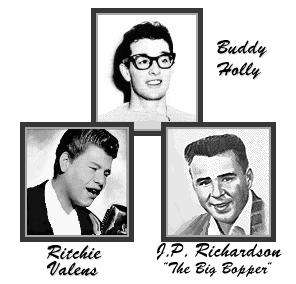
 Last week I watched ‘La Bamba.’ It’s the semi-biographical account of the rock legend Ritchie Valens, who would ultimately die in a plane crash only eight months after starting out his very short-lived career—he was only 17! He died in the same plane crash that killed Buddy Holly and the Big Bopper in 1959; a day which would eventually be known as “The Day the Music Died.” These three young rock stars were just at the start of what might have become some very successful music careers. Many musicians have lamented this musical loss; Don McLean’s well-known single ‘American Pie,’ chronicles the demise of the three stars that fell out of the sky as well as the death of what he saw as pure rock ‘n’ roll. I absolutely love this type of music and how it fused elements of country music with that of ‘race music’ or rhythm and blues. It was still in its infancy when they passed away, but it was the start of a truly American art form.
I grew up listening to this genre of music and was infatuated with the ‘La Bamba’ soundtrack because of all the great rock tracks. In fact, it was one of the first CDs I can remember my dad buying. We must have bought a CD player around 1987 because that’s when ‘La Bamba’ came out. It’s hard to believe that that was twenty years ago! Anyway, I remember listening to all of Ritchie Valens hits that included ‘La Bamba,’ ‘Donna,’ and ‘Come On, Let’s Go.’ All my brothers and sisters used to get so energized listening to the music that we’d start dancing and jump all over the room. Of course, this caused a lot of problems for those first generation CD players that tended to skip if you even breathed too hard around them. I also loved to open up the jewel case and take out the little inset that accompanied all CDs at the time and flip through the pictures and lyrics—I’d do this for hours sometimes while listening to the tunes.
However, I haven’t done this in awhile. The main reason is that I don’t buy CDs anymore, or hardly ever I should say. I know that I’ve touched upon this before on this personal journal-like blog of mine, but I can’t help but comment a little further on this subject in light of Radiohead’s new tactic of distributing their music. If you haven’t heard, Radiohead has decided that instead of compiling their music on a CD with the help of a major record label, they would just dole out the music themselves by selling it in the form of a download from their website. Here’s the rub: Radiohead decided that the fans could decide how much they were willing to pay for their newest installment. In other words, if the casual fan felt like just downloading it for nothing, then that’s totally fine. Personally, I’m not sure what kind of fall-out this is going to have on the music industry, but here’s some thoughts:
While Radiohead’s announcement might come across as commercial suicide, some are hailing this as a musical revolution for an already defunct and archaic system. Advocates are even saying that downloads are turning into promotional tools to sell concert tickets. In other words, the price of music has fallen so dramatically in recent years that giving the music away for free is just a way to get more people to come to a band’s show. Of course, the impact on the record labels has been catastrophic as their bread ‘n’ butter (CDs) have become as cool as eight-tracks. The famous record producer, Rick Rubin, who was recently appointed co-chairman of the
Thus, while major labels are scrambling to squeeze out any money from hot bands, the artists themselves seem to be making out okay. Attendance of arena shows is up 11% from last year. Music festivals are in the upswing. Bands seem to be raking in the dough as they offset their dwindling CD sales with increased concert prices; most fans aren’t even complaining as they watch their favorite artists in the flesh. As Robert Sandall put it: “They have rediscovered an ancient truth that music is, at root, a communal experience as much as it is something that goes on between your ears.” Some in the industry have even mused that music is now becoming more of a passion for people than even before CDs because of the increased accessibility to music.
The Radiohead method has already forced people to question how much music is actually worth. While there will of course be freeloaders, some people are really shelling out the dough for the new licks because of their fervor for the band. Money for artists is generally made through record contracts and touring and not through the CD. I think I once read that artists generally make about $2 for an album that probably retails around $14.99. Thus, paying for music for your favorite band could essentially turn into a donation for the appreciation and continuation of their music. So, how much would you pay for your favorite Kanye West, Josh Groban, or Metallica album?
I would gladly pay upwards of $20 for an album from a band I consider great—I have no problem with this. For instance, when ‘Red Hot Chili Peppers’ came out with their new double album last year, I made a B line to the nearest Best Buy and forked over the cash for the CD. And, to be honest, I really relished in putting in the CD and looking at the inset of pictures. Of course, I ripped the CD to iTunes, stuck the CD in the shelf, and haven’t picked it up since.
My point is: I would pay for music from bands I really like because I want to support them. If bands couldn’t continue to produce music because they couldn’t make money off of their trade, then I really think that that would be tragic. So, then my issue then becomes: what do I do with bands I’ve never heard of? I have a problem with shelling out even $10 for a CD from a band when I’m only familiar with one or two of their songs. I guess this is why iTunes seems to work for me. I can spend $1 on a song that I’ve heard somehow and transfer it over to my personal catalogue of fabulous music. If I continue to like the song, then I might buy some more tracks from that artist. Eventually, I might even hand over some money to go to one of their concerts.
So, is this really the end of the music industry? No. I just think it’s a shift in the way music is distributed. It calls into question what the purpose behind record labels is. I would have to say that their main function is to promote an artist so that their music can be heard far and wide. Thus, instead of producing CDs to be able to sell them in stores, music labels might become more like PR firms that specialize in selling an artist, not just a piece of plastic. This, of course, would mean that record labels would have to receive a bigger share of concert revenues, merchandise, TV spots, etc. as compensation for their services. Maybe if they just took a page from a certain rock ‘n’ roll chronicle it would make their situation a little easier:
I can still remember how
That music used to make me smile.
And I knew if I had my chance,
That I could make those people dance,
And maybe they'd be happy for a while