Showing posts with label soap box. Show all posts

Saturday, March 22, 2008

A Duty-Dance with Death

When a Tralfamadorian sees a corpse, all he thinks is that the dead person is in a bad condition in that particular moment, but that the same person is just fine in plenty of other moments. Now, when I myself hear that somebody is dead, I simply shrug and say what the Tralfamadorians say about dead people, which is 'So it goes'. (27)

Lost
recently ended its eight episode run, but will be back for five more episodes in one month’s time. The last episode had a lot to do with a character that I was sure we’d finally be rid of, yet for some reason the creators decided that there was a need to bring him back. Thus the episode was probably my least favorite of an amazing plot-forwarding season four. Before this character, Michael, left the series, he would always shout: ‘They’ve got my boy!!’ over and over again. The Others had taken his boy at the end of season 1 and for all of season 2 Michael only had one objective: getting his boy back. This motivation, of course, was an excuse for him to do whatever he needed to get his offspring, which included killing two main characters (Libby and Ana Lucia).

What's interesting is that Ben (the Others' puppet master) pointed out in the last episode that he never asked Michael to kill; Michael did it all on his own. In the lastest episode it's revealed that Michael decides to tell his son Walt about what he did to get off the island, thereby shattering their relationship which has devolved into estrangement. This is too much for Michael to bare. We’re not exactly sure about the details, but apparently Michael has now decided that a self-inflicted death is the only option left. He’s ruined the only thing that he loved and he’s at the end of his rope. But there's a catch: as Mr. Friendly (aka Tom) pointed out, ‘The Island won’t let you’ just kill yourself—it’s not that easy.


Michael's failed attempt to blow up the freighter is met with a little note

After several unsuccessful suicide attempts, Michael finally realizes that he has no escape from his past sins (killing innocent blood) and current hell (guilt and separation from Walt). Maybe the writers decided that in an attempt to make us sympathize with this damned character, his penance will be to somehow rescue his ‘friends’ that are still on the island, while acquiescing to Ben’s demands by killing some of Ben's enemies. Thus Michael has graduated from Ben’s chessboard pawn to Ben’s queen: nothing to lose and the willingness and motivation to kill.

You see, Michael cannot die and he has nothing to live for. His future is somehow laid out before him according to the island’s wishes and demands, and he has sunk into fatalistic realization of his own destiny. The difference between Michael and Desmond is that Desmond feels like he can still determine his future somehow, even though it’s bound by some immutable laws of inevitability (i.e., Charlie’s death). Desmond can control actions, however, and chooses the details of when and how things come to pass. I believe that Michael will become the Billy Pilgrim of Lost: the ill-fated character of Kurt Vonnegut’s Slaughter-House Five.


Slaughterhouse-Five or the Children's Crusade: A Duty Dance With Death

I recently re-read it since the author, Kurt Vonnegut, passed away last year. Have you ever read it? You must. The main character is “unstuck in time,” meaning that he experiences the events of his life in a seemingly random order, with no idea which part of life he will “visit” next (something akin to flipping through the channels of your own life). This has something to do with the fact that he has been adducted by aliens who don’t hold the same concept of time as humans. To them everything always exists at the same time. The author uses these aliens as a literary tool to satirize the idea of fatalism, or the acceptance of all things and events as inevitable. One alien said: "I've visited thirty-one inhabited planets in the universe... Only on Earth is there any talk of free will." I think that Vonnegut is satirizing this concept because so many people feel like they can’t change their own life. But the thing is…we do have free will. We can’t just sit around and wait for life to happen to us; we are masters of our own fate.

I think that ultimately Lost and its characters will begin to understand this concept of fatalism on a broader scale, as they come off the island and have ‘unstuck in time’ experiences. This may be why Jack tries to kill himself in the future by jumping off a bridge, or that Hurley tries to get into a car accident and ultimately ends up in psychiatric ward where he feels ‘safe.’ This is just a theory, but it feels like time-travel has become a central theme of Lost this season wrapped around theories brought to us by Vonnegut, who has been mentioned at least three times during the eight episode run. If this were to be true, then we’ll see more characters turning to suicide (freighter folk), going insane (Minkowski), or maybe developing a sickness (Rousseau’s comrades). Ultimately, I believe that the characters will all have to face their past demons and reconcile those with the island (aka smokey) and themselves in order to find peace and become masters of their own fate. Only then will they truly become ‘found.’

Tuesday, February 19, 2008

I Was on the Tonight Show!

I had quite the Presidents’ Day weekend. No, it had nothing to do with presidents of the US of A, but more with F.U.N. That’s right. Emma and I went to SoCal along with part of my family. Unfortunately, I didn’t take any pictures of them I just realized. Steve, if you’ve got any extra footage of us in the Teacups I’d like to see it. I’m pretty sure we beat Emma and Naomi in the speed factor, but I need proof.

I flew out on a Thursday and decided to rent a car, which I had never done. I was a little nervous, but I ended up with a pretty sweet little ride for not much money. Is it normal to pay about $16 per day?? I have no idea. I used my mom’s Costco card or something in order to get a discount. I was thinking I was gonna get some old compact beater, but I ended up with a Chevrolet Cobalt Sport that had under 10,000 miles on it. It was actually pretty fun.

Of course, this opened up the door to the wonderful world of Southern California’s freeway system. I had to find where my sister and her family was staying at, but couldn’t even if my life depended on it. (Which I thought it did during one sketchy encounter with a gas station attendant.) Apparently, in this part of the world, it’s okay for roads to disappear and suddenly reappear. I still have no idea how Firestone Blvd. exists as a thoroughfare—I’m almost positive that it’s really a black hole or some sort of TV prop from the hit show Punk’d.

Well, I eventually did make it to the hotel with no help from the car rental agent, or the two English-as-a-second-language gas stations attendants who attempted to help me on my futile journey at 11:30 at night. However, I was rewarded with a snug place on the floor to rest my head. I’m not complaining, it was just a little hard.

The next day was Universal Studios/Hollywood Day. I have this friend, Kristian, who has an enormously entertaining blog, if you’re interested. He works for NBC/Universal in the Burbank area. I asked him if we could get some tickets to the Tonight Show knowing that he had worked there before, but my anticipation level was quite low since I had only asked him the day before. But Kristian, the miracle worker, pulled some strings and got us some free tickets to see Jay Leno!

I have to be honest. I’ve been a huge fan of the Tonight Show since Johnny Caron. Being able to watch one of these late-night comedy shows is a kind of a life long dream of mine. I do have other dreams, don’t get me wrong. But I grew up watching these shows mainly with my dad and they’ve kind of become part of my collective childhood memories. So, I’m deeply indebted to Kristian. I did get him some CPK, so hopefully that makes up for it somewhat.

Before I explain what happened on the show, I just wanted to say that Kristian also volunteered to give us a free tour around Universal Studios. I’ve been on this tour before, but getting taken around in a golf cart while giddy stargazers snapped photos of us because they thought we were celebrities was pretty cool. I’ve posted a couple of pictures on here for your enjoyment.


One more thing; Kristian pointed out at the end of the tour that Conan O’Brien is taking over for Jay sometime next year. Conan is getting a brand spanking new studio to go along with the prestigious promotion and we were able to glimpse the outside of it. Keep this in mind.

Emma and I, along with her friend Tara, then headed off to the show. I wish I had pictures of our little outing, but unfortunately you’re not allowed to take pictures in the studio. Nevertheless, we were all still very excited for what lay ahead. Now, I’ve been told this before, but the studio really does look a lot smaller once you’re inside. I don’t know what it is, but Kristian says that the cameras they use are somehow specially equipped to make it look like it’s bigger somehow, but I don’t remember what he said.

I wasn’t expecting to get good seats, because we were so far behind in the line when we entered the studio. But it’s not a first come, first serve basis; the pages that work there actually sit you depending their whim. Fore some reason, we just happened to get three seats in the second row right in front of Jay. I seriously almost wet my pants. Jk ;)

This was about three in the afternoon. The show actually films extremely early even though they call it the Tonight Show. I believe that part of the reason they do this is because of the Eastern time difference. Of course, the Late Show with David Letterman still shoots pretty early, even though they don’t have to deal with a time difference. Anyway, I kind of already knew this, but what I didn’t know was that during the commercials of the show, they actually stop the show for the exact same amount of time that it takes to air the TV commercials. Meaning that when he pauses for a break, he actually pauses for a break and gets make up applied or something. Also, they don’t edit the show really at all, which means that if there are any mistakes those get put into the show.

Before the show started Jay came out and kind of told us all of this. He was wearing his denim shirt that he always wears when he’s not wearing his suit. He was personable and pretty quick-witted, which isn’t surprising, but still amazing to watch live. He’s a little shorter and stouter in person that what appears on the TV, but this wasn’t that surprising either.

The show starts filming at 4:00 and pretty much goes for an hour. When Jay first comes out some of the audience goes up to the front and shakes his hand. Since I knew this I grappled my way up to the front and pretty much nabbed his hand as he was trying to shake someone else’s. It was awesome. You can actually see me on TV if you want to check it out here. It's the February 15 Friday episode.

I was pretty much psyched out of my mind at this point, so I wasn’t expected anything else of that caliber to happen. But during the program, on this particular episode they decided to do this thing when audience members can ask Jay a question. I sat there and listened to various members of the audience ask Jay something stupid, so that they could set him up for a joke. A few minutes went by and I knew I needed to say something. So, I raised my hand. As soon as I did Jay called on me. I didn’t really know what I was doing, so I didn’t wait for the mic or for the spotlight to shine on me or anything—I just blurted out the first question that came to my head: ‘So, I noticed today that they’re building a new studio for Conan O’Brien, it looks pretty big….’ I wasn’t able to finish my question—before I could blurt out, ‘what do you think about that?’ he started into his joke. Something about how NBC was building a cathedral for Conan made out of solid gold, with a throne and candles to boot. It was pretty funny. I’d like to think that I made America laugh somehow. See here. It's the second chapter: Jay's Open Mic.

After that, we headed out into LA rush hour traffic. That wasn’t as fun. But still a pretty good start to the Presidents’ Day weekend.

Sunday, February 10, 2008

The Continuing Saga of Sundance

I’m sorry that this post has taken so long. Everyone’s probably already lost the majority of their interest in Sundance, but I wanted to chronicle my entire experience and so I’ll just add this final one.

On Tuesday of the second week of Sundance I saw this movie called the Adventures of Power. Honestly, I really enjoyed this movie—it was probably my favorite Sundance movie that I saw—but when I saw it I was kind of in a bad mood, so I don’t think I appreciated it as much as I could have. It’s a pretty light-hearted comedy that owes more than a little to another Sundance breakout hit, Napoleon Dynamite. The editing is a lot more fast-paced for sure, but the quirkiness and eclectic feel have Napoleon Dynamite written all over it. Not to mention that the star and director look suspiciously like Jon Heder in his first starring role. Therefore, if you enjoy unconventional offbeat humor wrapped around the premise of ‘air drumming’ then you should definitely give this little movie a try. That’s if it gets picked up by a major studio. Thanks again, Christian for the tickets.


My next Sundance experience was a concert. Emma and I went to go see the Aggrolites at the Kimball’s Art Center. Again, in order to get into these concerts you have to have credentials. I didn’t this time, but Emma actually knew the band from when they performed on the hit kids TV show Yo Gabba Gabba, which Emma was on. The concert was extremely small and was really conceived for the Sundance ‘uppities’ with their important credentials. This meant that the band was performing for a bunch of people that were only there to flash their credentials and say they went to the concert, in other words, they weren’t really fans. This created kind of a lounge bar feeling: an act performs with great panache, but the elitists are too busy sipping their drinks and schmoozing to really take notice. However, the Aggrolites released some exclusive tickets on their MySpace page to their most loyal fans, which meant that there were probably twenty-five to thirty people there who actually cared. And the band delivered. They’re kind of a reggae-rock band akin to 311, but with more allegiance to the ska realm of the musical universe. Anyway, it rocked and we didn’t get a ticket for illegal parking. Yay!


Our final Sundance venture happened at 9:15 on a Saturday morning. (Getting Emma to go anywhere at this time in the morning is a minor miracle. jk.) We went to go see this movie CSNY: Déjà Vu. It’s about the aging rockers, Crosby, Stills, Nash, and Young, on their "Freedom of Speech Tour" in 2006 that was the equivalent of a political rally for anti-war sentiment. Let’s see, I don’t mind people speaking their minds and letting their frustrations out through song, but to create a documentary about pulling out of Iraq, built upon weak 60s sensibilities and simplistic melodrama isn’t the way to really influence policy or difficult decision-making. Here’s what one commenter said on the movie’s IMDB webpage:

Sundance Moment: Someone in the Q&A said that he had lost a brother in Iraq, and told Neil Young that "you have no idea what you're talking about." It was a tense moment in the very liberal Sundance crowd. I'm guessing that Young has dealt with this kind of thing dozens of times on the tour, and he chose to handle it by, essentially, backing down. "I think you're right," he said. "We're just trying to get people to talk about it." Well, that might be an easy answer, but I'm not sure it's honest. A song like "Let's Impeach the President" is something more than an invitation for dialogue; it's a political statement of the strongest kind. I respect the band's sincerity, but was disappointed they were something less than forthright when challenged.

Here, here.

Anyway, thanks again Christian for the tickets. Apparently all of CSNY were there that morning at the screening, but we failed to even look for them. That was stupid. We then went out to eat at Loco Lizard and decided to take a picture.

So, Sundance is over for now. When worked correctly you can have a pretty good time when Hollywood turns its spotlight onto little ol’ Park City. I really enjoyed myself this year, but it’s also kind of a headache. It’s kind of like when your relatives come over to visit you: it’s great to see them and listen to all they have to say, but soon enough you can’t wait for them to leave.

Saturday, February 2, 2008

Connecting at Sundance

The next big day was on Monday or MLK Jr. day. I started off the day by skiing with my honey. Parking again was a mess, but thanks to my bro-in-law, Steve, we were able to get some pretty sweet underground parking. (Thanks Steve.) We then took public transit again to Main Street where we were able to see a couple of bands. We wanted to see Ingrid Michaelson, but because we missed our transit connection, we got their too late.


However, we did see Sea Wolf at the Music Café. It’s a pretty cool little venue and the only way to get in is by having ‘credentials.’ I, of course, don’t have credentials, but I borrowed some from work and I was consequently known as ‘Alison Butz’ the rest of the day. No really. The little concert was actually extremely awesome, mainly due to the band itself, but the intimate atmosphere and ability to be really close to the band was priceless.


I kept trying to film them, but I got in trouble. Then I took some pictures of them, but got in trouble because of the flash I was using. This lady must have felt bad for berating me so much because she gave me and Emma a couple of free CDs at the close of the show. Since we were so close to the band we went up and talked to them. Emma told them that they looked really peaceful. Not wanting them to feel like we had just finished singing hymns or something, I hurriedly told them that they rocked. They then signed our CDs. Now, that really did rock.


After finding a place to eat (thank you Davanza’s) we met up with my buddy Christian and his date (friend?) Whitney. We then took the lovely public transit over to the Racquet Club. I was worried that they’d give our seats away since we were getting there only fifteen minutes beforehand, which is customary. Luckily, we didn’t have any problems finding some seats, but we couldn’t exactly sit right next to each other. It was during this time that we were able to spot Quentin Tarantino directly across the aisle from us. I took a very quick and blurry picture because I didn’t want to feel like a gawky fan, which is why I didn’t take a second. Stupid.


So here’s the rub: with Sundance you really never know what kind of movie you’re gonna see. You can read the small little snippets before you go, but this isn’t as useful as you might think. I didn’t choose this movie on purpose; we were going because I got free tickets at work. The move was called Sleep Dealer, and honestly, after watching the movie, I’m not entirely sure why it was called that. I knew it was a sci-fi before going in, but I had no idea it was going to be ninety percent in Spanish. Think about it—a Mexican science fiction movie—that’s kind of weird isn’t it? Well, it was kind of weird, but at the same time wonderful. It was a simple story about a dystopian not-too-distant future on the Mexican/American border. The special effects were amazing for a low budget film, but for blockbuster cinema it would’ve been almost laughable. The cinematography was great and the acting top-notch, but the story was almost too quaint to be honest.


Science fiction is about turning all your traditionally held beliefs on their ear; but the major themes in the film seemed almost like retread for me. For instance: becoming less connected to humanity in a world that’s becoming more digitally connected seems like it could’ve been a cautionary public ad or something. Science fiction is supposed to scare you to the core; it makes you say, “I pray that our future could never be like that.” But this movie made me think, “hmm, the future doesn’t really sound that bad.” Am I a (gulp) becoming too much of a realist, too much of pragmatist? Maybe, but I think the filmmaking was just a little soft, if not delicate—which would’ve played out well for a rom-com, but not so much for sci-fi.


However, I must say that I thoroughly enjoyed listening to the director and principle cast members giving their two bits about the movie after the credits had rolled. I think I liked the movie a little more after this, but that’s like saying you enjoyed a joke after someone explained the punch line to you. You appreciate the joke for its creativity, but you’re still not sure why you just didn’t ‘connect’ with it to start.

Sundancing with the Stars, er, kind of...

I’ve lived in Park City off and on for the last twenty-odd years. I love and hate it sometimes. I love the snow, skiing, and the small-town mentality, but once a year my little home town turns into Hollywood on ice. While I find Sundance intriguing in a way, I also find it incredibly annoying with all the extra traffic, wannabe stars, and uber fan gawkers. While I can’t help but get caught up in the frenzy a little, I’m also apt to complain – call it human nature. But this post won’t dwell on the headache induced aspects of Sundance, but rather the parts that I enjoyed and participated in. I was originally going to give day-by-day updates of Sundance happenings, but I’ve found myself extremely busy at work and tired at home, thus postponing my desire to write something for my faithful readers, yes all two of you.

Sundance officially begins on Friday, but the traffic begins a couple of days before. Now, when I say traffic, I mean traffic. Usually it takes me only 15 – 20 min. to get home from work; this is usually doubled during Sundance or even longer. Plus, I’m not allowed to park in my own parking lot for work. I’m not sure why this is, but it’s so frustrating. I have to take public transit everywhere.

Anyway, on Friday of the first week a couple of my friends went to go hang out on Main Street during our lunch break. Now, let’s be honest, you could spend the whole day looking for celebs and never see any—I know I’ve looked. So, our Main Street venture was supposed to be pretty lame because that’s what I was expecting—and for the most part it was. But I did run into the one and the only Ian Ziering from 90210 and Dancing with the Stars fame. I know, you’re all pretty shocked and awed by this, but that’s how I roll. Usually I wouldn’t brag about this, but that’s what blogs are for, right??

Monday, December 3, 2007

'Enchanted': A Postmodern, Traditional Fairytale

It would be safe to say that Disney almost single-handedly invented the so-called princess genre when it began to unspool its female heroine films starting with Snow White (1937) and ending with Beauty and the Beast (1991). These princess movies all contain similar elements: traditional princess storylines, 2D animation, and a Broadway-musical theme. Lately, however, Disney princess fare has taken a backseat to the ever-popular CGI movies that fly in the face of traditional 2D-animated princess fairytales or even make fun of them (Shrek). In fact, Disney's own animation department had at one point left the 2D technique by the wayside with the decidedly below-average Home on the Range (2004)—they've only recently decided to revamp this almost defunct art. Also, they haven't even attempted a Broadway-style movie since Mulan (1998), which is interesting because Disney was the only movie studio making movie musicals with any success during the late 80s and early 90s (see The Little Mermaid, Aladdin, Beauty and the Beast, The Lion King, et al.) This is unfortunate since musicals seem to be back in vogue with the likes of Moulin Rouge, Chicago, Hairspray, and Sweeney Todd singing themselves back onto the silver screen with critical and commercial success. So, the question is: Why not make another Disney princess movie with all the methods that made it a masterpiece (i.e., traditional animation, song and dance, as well as a 'happily ever after' storyline)?

After watching Enchanted with my girlfriend, (we both loved it) we started to discuss the dearth of classic Disney princess musicals. I was of the opinion that those types of movies just wouldn't work for America's current taste. They would be a tough sell in today's Shrek-inspired market that relies heavily on poking fun at all things conventional for the sake of buzz-inducing irreverence. I'm not trying to bag on Shrek or its conglomerate of clones; I'm just saying that 'the mockery' has taken place of 'the masterpiece.' The cynical post-9/11 audience has now become accustomed to sarcastic, biting humor engineered to lampoon tradition, rather than embrace it—stuff that would make Walt Disney rollover in his cryogenic freezer. This phenomenon has even transcended into the Broadway realm as it seems that the most popular and award-winning musicals are parodies (i.e., The Producers, Spamalot, etc.). This entertainment trend in the realm of 'family' entertainment might even be considered to be 'postmodern.'

So, let's examine postmodernity with Enchanted as the prime example: Now, 'postmodern' is an ambiguous term thrown about by quasi-intellectuals (ahem) that has a cornucopia of meanings. The meaning that I wanted to evoke is the following: 'the breaking of traditional frames of genre, structure, and stylistic unity" (Wikipedia). Thus, Enchanted may work on a lot of levels, but I think its success is mainly due to Disney's self-parody of the princess genre that it created. Here's a 'for instance:' While watching the opening 2D-animated sequence from Enchanted--that ripped storylines from Snow White, Cinderella, and Sleeping Beauty--I felt that it wasn't meant to be an homage to these movies, but rather a spoof. The audience understood this and they all laughed. In other words, Disney wasn’t presenting to the masses a classic, traditional princess archetype replete with brilliant music and color, but a mimicked replica of those old films with its tongue planted very firmly in its cheek, as if to say, "we know these types of movies don't work anymore either," wink, wink. It would be the equivalent of the creator of Star Wars, George Lucas, deciding that his movies just weren’t connecting to his fanboy audience like they used to, so he decides to broaden the audience and reimagine the next Star Wars movie into a romantic comedy, When Anni Met Padme, for example. While this does intrigue me a little, I’d be a little remiss that all my Star Wars memories as a kid would be thrown out the window for the sake of George Lucas’ creative urges (oh wait, this already happened). My point it: while I think movies or genres are always in the need of an update, sometimes it just makes me a little sad to think that America’s mood and taste has shifted so much that making a traditional, yet exceptional movie has become the extreme, while making those cutting-edge, pushing-the-envelope-type films has become the norm.

Scene from When Anni Met Padme

Here's a look at Enchanted and it's less-than-traditional undertones: (1) McDreamy is a divorce lawyer that pushes feminist heroines on his impressionable young daughter. I like the fact that he's trying to push realistic ambition into his daughter, but I have a hard time imagining Walt Disney adding in a scene like this for any of his movies. (2) The evil queen (Susan Sarandon) sends Giselle (the princess) to a place where "there are no happily ever afters." First of all, to suggest there are no ‘happily ever afters’ kills all traditional princess credibility, but then to have the no ‘happily ever after’ place become the princess’ home by the end is downright pragmatic (?). Secondly, a reference to the ‘real world’ was unheard of in earlier Disney movies, and yet today it seems like all CGI movies survive off of pop culture jokes. It would be like Cinderella’s fairy godmother singing, “Bibbidi-Bobbidi-Boo, the Commies are out to get you!” during the Red Scare 1950s. I just don’t know if those types of jokes stand the test of time. (Have you watched the first Shrek movie in a awhile?) (3) The princess saves the mansel (man + damsel) in distress (McDreamy). Again, in the oft-mentioned Disney princess movies, even if the princess was the main star of the show, she was always saved by the prince. I guess this just mirrors today’s political climate, as Hillary Clinton (a modern-day princess?) has always had to save her own mamsel in distress.

Then again, I could be completely wrong. While Enchanted could come across as a poke in the eye of all things princess, it really ends up very traditional in the fact that everyone really does end up 'happily ever after'—as my girlfriend pointed out. In fact, to weaken my argument of this postmodern trend, Disney is ready to get back into the princess movie making game with a pair of future releases. The first is The Princess and the Frog, which is being touted as a return to 2D animation for the Mouse House with singing and dancing for all. The interesting twist for this movie is that it will star Disney's first African-American heroine, who was recently called Maddy, until the PC police decided that it was too racially insensitive. Her name is now Tiana. The other princess-themed movie scheduled to hit theatres, is Rapunzel. However, instead of going with the traditional 2D-animation, the studio has recently decided to mix the best of both worlds of 2D and CGI. Here's what Wikipedia had to say: "Because of the advancements in computer technology many of the basic principles of animation used in traditional animated movies that has been absent in CGI films due to technical limitations, is now becoming possible also in this field of animation, where they will be used together with the potential offered by CGI." Thus, they plan to animate the movie as if it were a traditional oil painting on canvas. Intriguing. It sounds so, well,…traditional.

The Swing, the artistic inspiration for Rapunzel


I wanted Yoda to be the traditional kind of character you find in fairy tales and mythology. And that character is usually a frog or a wizened old man on the side of the road. The hero is going down the road and meets this poor and insignificant person. The goal or lesson is for the hero to learn to respect everybody and to pay attention to the poorest person because that's where the key to his success will be.


- George Lucas


Disney theatrical animated features

Snow White and the Seven Dwarfs (1937) • Pinocchio (1940) • Fantasia (1940) • Dumbo (1941) • Bambi (1942) • Saludos Amigos (1942) • The Three Caballeros (1944) • Make Mine Music (1946) • Fun and Fancy Free (1947) • Melody Time (1948) • The Adventures of Ichabod and Mr. Toad (1949) • Cinderella (1950) • Alice in Wonderland (1951) • Peter Pan (1953) • Lady and the Tramp (1955) • Sleeping Beauty (1959) • One Hundred and One Dalmatians (1961) • The Sword in the Stone (1963) • The Jungle Book (1967) • The Aristocats (1970) • Robin Hood (1973) • The Many Adventures of Winnie the Pooh (1977) • The Rescuers (1977) • The Fox and the Hound (1981) • The Black Cauldron (1985) • The Great Mouse Detective (1986) • Oliver & Company (1988) • The Little Mermaid (1989) • The Rescuers Down Under (1990) • Beauty and the Beast (1991) • Aladdin (1992) • The Lion King (1994) • Pocahontas (1995) • The Hunchback of Notre Dame (1996) • Hercules (1997) • Mulan (1998) • Tarzan (1999) • Fantasia 2000 (1999) • The Emperor's New Groove (2000) • Atlantis: The Lost Empire (2001) • Lilo & Stitch (2002) • Treasure Planet (2002) • Brother Bear (2003) • Home on the Range (2004) • Chicken Little (2005) • Meet the Robinsons (2007) • Bolt (2008) • The Princess and the Frog (2009) • Rapunzel (2010)

Tuesday, November 20, 2007

Publicly Funded Sports Stadiums and Wal-Mart

I was recently reading a news article in the DesNews about the Real Salt Lake soccer stadium. It was interesting because it was really just pointing out the obvious fact that with the debt issued by the county via a 20-year bond that interest would make the stadium price tag considerably higher. I think most people knew that already, and were willing to accept the fact that it would be expensive, but saw it as a welcome economic development opportunity for Sandy. While I am, along with much of Utah, intrigued by sports and believe that having more professional sports in Utah would be great, I can’t help but think that most taxpayers don’t really understand all the nuances of this already done deal. My friend Aaron (a frequent contributor to this blog) and I actually wrote a paper together about this subject almost a year-and-a-half ago that describes some of the issues surrounding the soccer stadium and our take on it. The information is a little dated, but still pertinent.


Finally, this blog really is dedicated to the apolitical entertainment musings that we have, but I can’t help but post something about this as a dedicated sports fan with fiscally responsible leanings. I’m pretty sure Aaron and I are in agreement, but he can post a comment if he feels like he wants to add anything.

Should Tax Dollars Be Spent on the

Real Salt Lake Soccer Stadium?

By:

Jedediah Briggs

and Aaron Smith

The State Legislature has recently approved a bill (HB371) that authorizes all counties in the state to levy a 1.25 percent tax on hotel accommodations to pay for tourism projects. This bill could help pay for part of the Real Salt Lake soccer stadium in Sandy. However, several independent polls already have shown that most valley residents oppose a taxpayer-subsidized soccer stadium. Thus, the county, not the people, will soon decide whether to use the new tax revenue toward funding the stadium, which could cost taxpayers upwards of $45 million dollars. Before the county puts forth the money, there are a few questions to consider:

  • Will the RSL stadium spur economic development in Sandy?
  • What are the benefits for Sandy in having a sports stadium?
  • What are the costs of subsidizing a new soccer stadium?

Will the RSL stadium spur

economic development in Sandy?

Intuitively, a number of people would argue that building a new sports stadium would spur economic development in the surrounding area, but some studies have shown that that simply is not the case. In fact, one study which analyzed the effect of professional sports on local economies in 37 metropolitan areas found that professional sports stadiums did have an impact in an area, but it was, at best, minimal. For example, in 1990, Maryland and Baltimore collected $3.4 billion and $528 million, respectively. For the city, the tax gain from the newly constructed stadium in Baltimore represented only .7% of the tax gain. In addition, personal income in Baltimore was almost $14 billion. Projected earnings for the stadium represent .15% of Baltimore’s total income. Maybe the citizens of Sandy should worry about whether there is an actual impact.

The question could also be raised as to whether sports stadiums increase income per capita in the cities where they are located. The aforementioned study took into account the entire sports environment of the city, including the presence of franchises, franchise entry and departure, stadium construction and renovation, the location of new stadiums and arenas, and the “novelty” effect of a new stadium or arena for professional sports. Of the 37 metropolitan areas in the sample, none of them had a measurable impact on the growth rate of real per capita income in those areas. However, in one case the arrival of a new basketball franchise in a metropolitan area increased real per capita income by about $67, but building a new arena for that basketball team reduced real per capita income by almost $73 in each of the 10 years following the construction of the arena—a net loss of about $6 per person. Much of the lack of economic development can be illustrated through a discussion of the substitution effect.

The substitution effect

It is anticipated that the new arena for Real Salt Lake would be funded in part by public dollars. Usually a large portion of tax dollars goes to public services, such as healthcare, education, and local infrastructure, but in this scenario, the tax payer is being asked to fund a for-profit business. The revenues from the soccer stadium will not be going directly back to the taxpayers of Salt Lake County, but to the owner of the team. There is a difference between giving incentives or tax breaks to a store like Wal-Mart or Ikea to build in your town and actually paying for the store to be built. If valuable tax dollars, which could otherwise be spent on public goods, are spent on funding a sports stadium it could diminish the ability of the local economy to produce other non-sports-related goods and services, which in turn would reduce local income.

There is a difference between giving incentives or tax breaks to a store like Wal-Mart or Ikea to build in your town and actually paying for the store to be built.

The substitution effect also has an influence on private spending. Utah households, like all others, have budgetary constrains, with a limited amount of income. With a new professional sports team in the area, or a new entertainment option, families might spend less on other forms of entertainment, such as dinner, bowling, movies, or shopping. If families spend more money on going to games and less on the local economy then it might have a negative impact on an area. A study of the recently built MCI Center in Washington DC concluded that the arena provided no actual increase in entertainment dollars spent, but rather served as an alternate way for money to be spent. Essentially, there are only so many dollars to go around, and there is simply a transfer of where a person’s money eventually ends up. In the case of the soccer stadium, money goes into the hands of a small number of owners and players who might not reinvest back into the community.

What are the benefits for Sandy in having a sports stadium?

There are some benefits related to having a new sports stadium and team to root for. However, most of the benefits are qualitative in nature, not monetary. There is evidence that cities with sports franchises have a renewed sense of civic pride—it gives the community something to rally behind. There is also the feeling of satisfaction associated with having a professional sports team carry your cities’ name across the country. Furthermore, the arena could be used for other purposes as well, such as social events and concerts. A sports franchise is politically popular. Many people throughout Sandy want a professional soccer team in their midst, which drives political motives to landing a franchise. However, these ideas, again, are rooted in political and social benefits, not monetary policy.

Furthermore, in the Salt Lake County proposal, the land surrounding the stadium will be developed, similar to the area around the Delta Center with the creation of the Gateway Mall. However, the previously aforementioned Washington DC study found that the MCI Center was only part of a major revitalization program. Economic growth in a city such as Salt Lake may have more to do with a rapidly growing population than a soccer franchise.

What are the costs of subsidizing a new soccer stadium?

At present, Real Salt Lake has projected an estimated cost of $145 million for the entire stadium project. Of that total price, Real management has asked that $45 million come from public funds. The public funds, Real management argues, will not be put towards actually stadium construction, but on developing land near the site, including a broadcast studio and hotel.

In order to raise the necessary funds for the stadium, the Utah state legislature has passed a bill that would call for a 1.25% tax on hotel guests. A further analysis of the proposal raises several concerns.

First, there are signs that Salt Lake County is developing a tax rate problem towards hotel use. A 2005 bill that passed through Salt Lake County voters allowed the county to tax hotels in order to expand the Salt Palace Convention Center. The legislation proposed by the state legislature would be the second such tax increase in Salt Lake County in less than a year. One side effect of continually increasing the tax rate on such a limited base (hotel users) would be a decrease in possible hotel use because of over pricing. If the tax rate, combined with the natural increase of hotel prices, becomes too high, there could actually be a decline in hotel activity.

Second, there is a sense that the bill is pitting political entities against each other. In the aforementioned 2005 bill, Salt Lake City put forth $8 million on any future expansion involving Real Salt Lake. That money has already been committed. Salt Lake City is subsidizing a major portion of the development, yet the city may not realize any economic gains, if there are any to be had at all.

Third, there is some concern as to public perception regarding the legislation. As the bill was passed on a state legislative level, local voters in Sandy, and throughout the state, were unable to vote regarding the bill. As citizens continue to lose autonomy on tax issues, there could be political fallout in addition to any economic side effects. Additionally, it may become progressively more difficult to increase taxes on more immediate needs, such as education, health care, and infrastructure.

...Real management has asked that $45 million come from public funds.

Fourth, and perhaps of most concern, the proposal will rely on a user tax. There are disadvantages to this tax. Because the tax is aimed at hotel users, the tax has a limited base. Traditionally, hotel taxes are targeted to tourism development, such as the 2005 bill on the Salt Palace. Additionally, with a user tax, there is an element of unpredictability. The ebbs and flows of tourism can affect the amount of revenue, as tourism is heavily reliant on a healthy economy. Also, tourism can be altered by political climate. The events of September 11th drastically changed tourist based industries. Additionally, natural disasters can also have a great influence on regional tourism. The combination of a limited and unpredictable base could lead to a serious problem in revenue stability.

Risky business

In addition to the concerns with the nature of the tax, there are also some concerns to be raised about Real Salt Lake and Major League Soccer in general.

Since its inception, the league has collectively lost over $200 million. Last year, the Los Angeles Galaxy became the first team to earn a profit in the history of the league, with a total of $200,000. Historically, there is evidence that the league has a revenue problem.

For example, since its inception in 1993, three of the original ten soccer franchises are now defunct. One of those teams, the San Jose Earthquakes, was a two-time league champion and featured several prominent national team members. Despite continually winning and sold-out stadiums in the soccer hot bed of California, the team failed to turn a profit.

Second, Major League Soccer has yet to garner a major television contract. Television contracts are vital to the success of major American sports, such as football, baseball, and basketball. Should Major League Soccer, and Real Salt Lake, hope to ever flourish; they will need to secure a contract. However, securing a TV contract is out of Real Salt Lake and any local government entity’s control. Even with a positive outlook towards the hotel tax revenue, the team may still be unprofitable. The other two now extinct teams, Miami and Tampa Bay, failed to succeed despite being in areas heavily populated by Latinos, the primary demographic of American soccer.

Finally, there is concern about the expenditure of team revenue. In the past, Real Salt Lake has committed to be part of Salt Lake County’s economic growth. However, the actual extent to which Real can participate is very limited. Typically, a major league soccer franchise has as much as sixty percent of revenues tied to player salaries. In addition, the day-to-day operations must also be furnished. There is little evidence to suggest that Real owners will be willing to take whatever revenue remains and put it towards economic development in the county.

Works Cited

Amelia Nielson-Stowell and Nicole Warburton. “Legislation Targets Funding of Stadium.” The Deseret News. 1 Feb. 2006.

Dennis Coates and Brad R. Humphreys, “The Stadium Gambit and Local Economic Development.” Regulation 23 (2000): 23.

Derek P. Jensen. “RSL’s Funding: A Hot Potato for S.L. County, Legislature.” The Salt Lake Tribune. 3 Mar. 2006.

Ed Lazere, “Would a Publicly Financed Stadium Pay Off for DC?” D.C. Fiscal Policy Institute, 2003, pp. 1-9.

Jack Bell. “A League Looks to Grow.” The New York Times. 2 April 2006.

James Quirk and Rodney Fort, Pay Dirt: The Business of Professional Team Sports, Princeton University Press, 1992, pp. 170-171.

Jamie Gadette. “Real Stadium Questions.” Salt Lake City Weekly. 27 Oct. 2005.

Mike Moffit. “Leaky Stadiums.” Stadium Subsidies.” 2006. The New York Times Company. Feb. 1, 2006.


Monday, November 19, 2007

“What does tracking mean?”

Well, Casey that’s a very interesting question, I’m glad you asked. Oh, and sorry it’s taken so long to respond.

To track” comes from the Dutch, meaning to ‘follow or trace the footsteps’—first recorded in 1565. Thus, ‘tracking’ in and of itself could conjure a host of meanings dealing with merely following something, but in terms of movie tracking, what I had meant to say, more specifically, would be tracking prerelease movie buzz. You see, movies are multimillion dollar investments by movie studios, their shareholders as well as a surprising number of banks. All of these parties are interested in how these movies are going to perform at the box-office because it will obviously affect their wallets. In order to minimize risk then, movie studios will ‘track’ the movies through a number of different areas before they are released to help determine what kind of impact they’ll have on box-office receipts. Increasingly, opening weekends have become extremely important to movies’ revenues as these three days account for 30 to 50 percent of total box-office take. Some of the companies that movie studios have been known to use are Buzzmetrics, Cymphony, and Motivequest. The information that they gather is so sensitive that most of it isn’t published for the public to view. However, there are other places you can look if you were to say bet on opening weekend take of a movie such as blogpulse, yahoo! buzz, or imdb’s Moviemeter Top 10.

Basically, like any investment, movie studios are just trying to forecast with the most accuracy possible. The main things that they look at in order to determine a potential box-office haul are the following: prerelease buzz, rating, genre, early reviews, theatre count, and the movie’s marketing budget. What’s interesting about reviews is that it’s been proven that the more ‘buzz’ surrounding a movie, the more likely it’ll open big for the movie studio on opening weekend—regardless of whether it’s positive or negative. However, if a movie is going to continue to make a lot of money then it needs positive ‘word of mouth’ after opening weekend that will propel movies into higher levels of revenues. For instance, the Matrix sequels are notorious for their second weekends dropping off by a large amount because of poor word-of-mouth (wom), proceeded by a lot of prerelease buzz. On the other hand, there are other movies (sleepers) that really don’t have a lot of buzz going into them, but because of strong wom continue to perform well. My Big Fat Greek Wedding is the ultimate example of this.

The most interesting thing about wom is that for a long time, it was really hard to quantify, but with the advent of weblogs, such as this one, there are now blog tracking websites that determine prerelease buzz as well as post-release wom. These blog tracking websites are now being used by major movie studios in attempts to forecast box-office proceeds. For instance, in relation to my other post, Beowulf was tracking high when compared to other holiday movie fare, so most industry experts knew that it would open at number one. And, from what I read, they pegged it a $30 million dollar opening weekend, which happened to be $2 million short of what it actually took in—not bad. Now, of course, its overall profit destiny might lie in the nimble fingertips of the blogosphere. And on that note, I think I might see it tomorrow. Any takers?


Finally, here's an interesting paper related to this subject. Exploring the Value of Online Product Reviews in Forecasting Sales: The Case of Motion Pictures

Thursday, October 18, 2007

And the Oscar goes to...


In spite of the fact that I think the Oscars, or any other award shows, are pretty meaningless, I can’t help but get caught-up in the whole intrigue surrounding these types of shows. What I mean to say, is that I don’t think because one movie wins Best Picture accolades that it really is the best movie of the year—that goes for actors, directors, etc. However, for the most part, I do think that a lot of the movies that get nominated are note-worthy and sometimes could even be considered landmark achievements in cinema. And since I’m a huge movie buff, I can’t help but take notice of films that receive a lot of Oscar buzz.

It’s mid-October, which is still pretty early to be talking Oscars, but the movie theatres seem to be replete with adult-themed-Oscar-potential films right now. After perusing some of the Oscar contenders I feel a little depressed, which is how I think these films are supposed to make you feel. That is, most of these films seem to tackle the tough and controversial issues that tend to leave the audience in a state of morbid gloom. So, while I’m not jumping at the bit to see most of these movies, I just wanted to give my take on some of the films and actors that have Oscar written all over them:

Atonement Nineteenth century period drama starring Kiera Knightley.

Hmm…didn’t we already see this movie—'Pride and Prejudice' anyone? It even has the same director. Ok, I won’t slam this too much, because 'Pride and Prejudice' was pretty good. I saw it—in a moment of weakness—with my sisters, mom, and sister-in-law. I really liked it. Anyway, if Kiera and her director-friend can produce the same magic from P & P, than look for some more Oscar noms.

Eastern PromisesRussian mob thriller starring Viggo Mortensen.

Kind of the same thing as Atonement; the director and main star have made a second similar-themed movie together that is receiving rave reviews. Aragorn was in a movie a few years back ('A History of Violence') that was supposed to be excellent. I never saw it, and I probably won’t see this one too, since it’s supposed to be extremely violent and Viggo even fights someone in the nude at one point!

Grace is GoneIraq war widower deals with death and life starring John Cusack.

This is one of the few movies that I really wanted to see at Sundance this year, but couldn’t get tickets. First off, I’m a huge John Cusack fan, (see 'Better Off Dead') but also I like the whole role-reversal thing of a husband having to deal with the death of his soldier wife and then having to tell his daughters about it.

In the Valley of ElahAnother Iraq war movie starring Charlize Theron and Tommy Lee Jones.

This one’s sure to have a lot of Oscar potential, since it was written by Paul Haggis, who wrote and co-wrote many of the latest films that earned or were nominated for Oscars (i.e., 'Letters from Iwo Jima', 'Flags of Our Fathers', 'Million Dollar Baby', and 'Crash').

A Mighty Heart Based on the real-life Marianne Pearl, whose journalist husband died in Afghanistan starring Angelina Jolie.

Eh, I probably won’t see this one either. It’s weird to think that Angelina Jolie did, in fact, win an Oscar many years ago.

Charlie Wilson’s WarI have no idea what this one’s about – starring Tom Hanks, Julia Roberts, Philip Seymor Hoffman, and Amy Adams.

I think the only reason this film is getting so much attention has to do with the fact that all of its stars have either won Oscars or were nominated for them. Even the director has been nominated five times!

Russel CroweStarring in 3:10 to Yuma and American Gangster.

Ok, even though this guy has some major anger management issues that he needs to deal with, that doesn’t mean he can’t light up the screen with his dogged acting chops. Shoo-in for an Oscar nod.

Michael ClaytonCerebral lawyer thriller starring George Clooney.

Critics loved it; the public passed. Oscar voters have fallen in love with Mr. Ocean—look for another best actor nomination.

Cate BlanchettStarring in Elizabeth: The Golden Age and I’m Not There.

Cate Blanchett is spot-on in anything she’s in. Oscar voters love her and she may just get a nom for playing a guy (Bob Dylan)!

Lions for LambsAnti-Iraq war story starring Tom Cruise, Meryl Streep, and Robert Redford.

Say what you will about Tom Cruise and his, um, eccentricities; he brings his ‘A’ game in everything he’s in. I think Meryl Streep gets nominations for just being in a movie. Bob Redford is a little hit-and-miss these days when putting out good material.

Denzel WashingtonStarring in Ridley Scott’s American Gangster.

Denzel has the goods, what can I say? He won an Oscar for 'Training Day', in which he played one bad mutha—similar to 'American Gangster.'

Daniel Day-LewisStarring in There Will Be Blood.

Anytime Day-Lewis ('Last of the Mohicans', 'Gangs of New York') decides to grace the screen with his presence (about once every three years) he always generates a lot of Oscar buzz.

No Country for Old MenCoen brothers’ modern noir film based on a Cormac McCarthy book.

I haven’t read this book, but I read McCarthy’s other book, ‘The Road’ and was completely floored.

Casey AffleckStarring in The Assassination of Jesse James and Gone Baby Gone.

So, everyone knows Casey as Ben’s younger brother and as one of the Mormon twins in the Ocean’s movies, but he’s also generating a lot of buzz for his method portrayal of the coward Robert Ford as well as headlining Ben’s directorial debut Gone Baby Gone.

Sweeney Todd Tim Burton’s murderous barber musical starring Johnny Depp.

Burton and Depp have teamed up on countless occasions (six of 'em) to very crowd-pleasing results, but this film could be what gets them into Oscar contention.

Keri RussellStarring in Waitress.

I’ve been a huge fan of Keri’s since her 'Felicity' days. This was another Sundance movie that I wanted to see, but couldn’t get tickets. I still haven’t seen it, but maybe more Oscar attention might spur me on to actually buy a ticket.

Monday, October 8, 2007

The Day the Music Industry Died

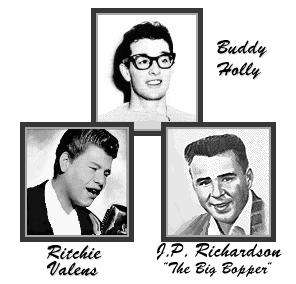
Last week I watched ‘La Bamba.’ It’s the semi-biographical account of the rock legend Ritchie Valens, who would ultimately die in a plane crash only eight months after starting out his very short-lived career—he was only 17! He died in the same plane crash that killed Buddy Holly and the Big Bopper in 1959; a day which would eventually be known as “The Day the Music Died.” These three young rock stars were just at the start of what might have become some very successful music careers. Many musicians have lamented this musical loss; Don McLean’s well-known single ‘American Pie,’ chronicles the demise of the three stars that fell out of the sky as well as the death of what he saw as pure rock ‘n’ roll. I absolutely love this type of music and how it fused elements of country music with that of ‘race music’ or rhythm and blues. It was still in its infancy when they passed away, but it was the start of a truly American art form.

I grew up listening to this genre of music and was infatuated with the ‘La Bamba’ soundtrack because of all the great rock tracks. In fact, it was one of the first CDs I can remember my dad buying. We must have bought a CD player around 1987 because that’s when ‘La Bamba’ came out. It’s hard to believe that that was twenty years ago! Anyway, I remember listening to all of Ritchie Valens hits that included ‘La Bamba,’ ‘Donna,’ and ‘Come On, Let’s Go.’ All my brothers and sisters used to get so energized listening to the music that we’d start dancing and jump all over the room. Of course, this caused a lot of problems for those first generation CD players that tended to skip if you even breathed too hard around them. I also loved to open up the jewel case and take out the little inset that accompanied all CDs at the time and flip through the pictures and lyrics—I’d do this for hours sometimes while listening to the tunes.

However, I haven’t done this in awhile. The main reason is that I don’t buy CDs anymore, or hardly ever I should say. I know that I’ve touched upon this before on this personal journal-like blog of mine, but I can’t help but comment a little further on this subject in light of Radiohead’s new tactic of distributing their music. If you haven’t heard, Radiohead has decided that instead of compiling their music on a CD with the help of a major record label, they would just dole out the music themselves by selling it in the form of a download from their website. Here’s the rub: Radiohead decided that the fans could decide how much they were willing to pay for their newest installment. In other words, if the casual fan felt like just downloading it for nothing, then that’s totally fine. Personally, I’m not sure what kind of fall-out this is going to have on the music industry, but here’s some thoughts:

While Radiohead’s announcement might come across as commercial suicide, some are hailing this as a musical revolution for an already defunct and archaic system. Advocates are even saying that downloads are turning into promotional tools to sell concert tickets. In other words, the price of music has fallen so dramatically in recent years that giving the music away for free is just a way to get more people to come to a band’s show. Of course, the impact on the record labels has been catastrophic as their bread ‘n’ butter (CDs) have become as cool as eight-tracks. The famous record producer, Rick Rubin, who was recently appointed co-chairman of the Columbia label, has ideas of refocusing the company into something akin to that of the cable TV business (i.e., making Columbia’s catalogue available for download while people pay a monthly subscription).

Thus, while major labels are scrambling to squeeze out any money from hot bands, the artists themselves seem to be making out okay. Attendance of arena shows is up 11% from last year. Music festivals are in the upswing. Bands seem to be raking in the dough as they offset their dwindling CD sales with increased concert prices; most fans aren’t even complaining as they watch their favorite artists in the flesh. As Robert Sandall put it: “They have rediscovered an ancient truth that music is, at root, a communal experience as much as it is something that goes on between your ears.” Some in the industry have even mused that music is now becoming more of a passion for people than even before CDs because of the increased accessibility to music.

The Radiohead method has already forced people to question how much music is actually worth. While there will of course be freeloaders, some people are really shelling out the dough for the new licks because of their fervor for the band. Money for artists is generally made through record contracts and touring and not through the CD. I think I once read that artists generally make about $2 for an album that probably retails around $14.99. Thus, paying for music for your favorite band could essentially turn into a donation for the appreciation and continuation of their music. So, how much would you pay for your favorite Kanye West, Josh Groban, or Metallica album?

I would gladly pay upwards of $20 for an album from a band I consider great—I have no problem with this. For instance, when ‘Red Hot Chili Peppers’ came out with their new double album last year, I made a B line to the nearest Best Buy and forked over the cash for the CD. And, to be honest, I really relished in putting in the CD and looking at the inset of pictures. Of course, I ripped the CD to iTunes, stuck the CD in the shelf, and haven’t picked it up since.

My point is: I would pay for music from bands I really like because I want to support them. If bands couldn’t continue to produce music because they couldn’t make money off of their trade, then I really think that that would be tragic. So, then my issue then becomes: what do I do with bands I’ve never heard of? I have a problem with shelling out even $10 for a CD from a band when I’m only familiar with one or two of their songs. I guess this is why iTunes seems to work for me. I can spend $1 on a song that I’ve heard somehow and transfer it over to my personal catalogue of fabulous music. If I continue to like the song, then I might buy some more tracks from that artist. Eventually, I might even hand over some money to go to one of their concerts.

So, is this really the end of the music industry? No. I just think it’s a shift in the way music is distributed. It calls into question what the purpose behind record labels is. I would have to say that their main function is to promote an artist so that their music can be heard far and wide. Thus, instead of producing CDs to be able to sell them in stores, music labels might become more like PR firms that specialize in selling an artist, not just a piece of plastic. This, of course, would mean that record labels would have to receive a bigger share of concert revenues, merchandise, TV spots, etc. as compensation for their services. Maybe if they just took a page from a certain rock ‘n’ roll chronicle it would make their situation a little easier:

I can still remember how
That music used to make me smile.
And I knew if I had my chance,
That I could make those people dance,
And maybe they'd be happy for a while

currently listening 2...


currently listening to...


jazz it up!